
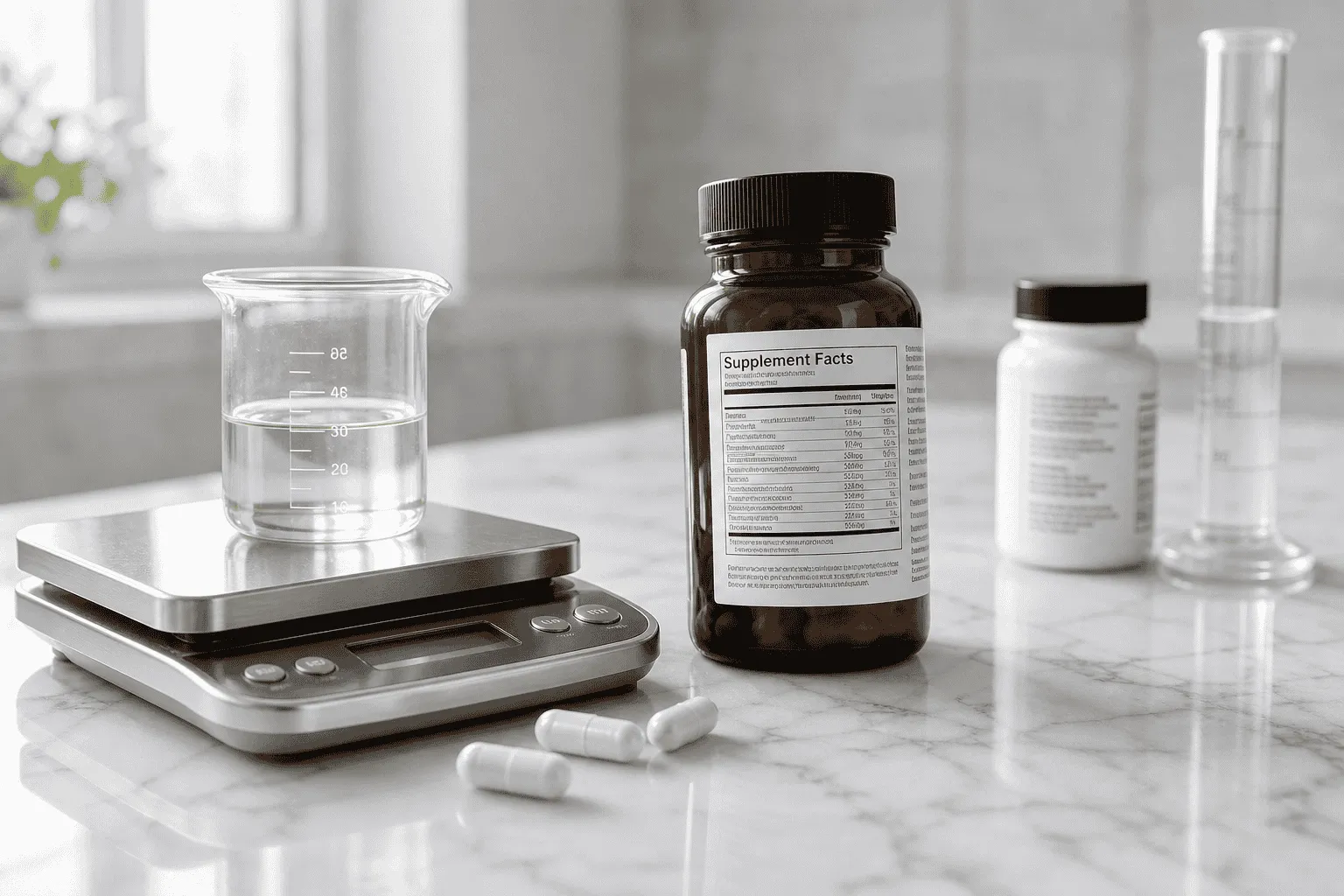
An ingredient amount printed per capsule is the amount in one capsule, not automatically the amount taken in a day or the amount in the whole bottle. Keep the unit beside the number. Multiplication can clarify what a label records, but it cannot decide whether you need a supplement or how much you should take.
That distinction matters when discussing products you already use while seeking help with hair or nutrition concerns. “The bottle says five” leaves several possibilities open: five milligrams of an ingredient, five capsules, or something else entirely. Read the complete line before shortening it into a number for a form or conversation.
Keep the amount beside its unit
Health Canada’s natural health product labelling guidance distinguishes ingredient quantities per dosage unit from directions and the package’s net contents. Those pieces of information do different jobs. The ingredient line describes what a defined unit contains; the directions describe the conditions of use; the bottle count describes the quantity supplied.
Read what the particular label says rather than assuming a familiar layout. Health Canada notes a transition period for new labelling requirements, with compliance due in 2028. You should not conclude that a current product is missing information simply because it does not resemble one newer example table. Find the relevant wording on the actual package or accompanying information.
Keep the measurement unit too. Milligrams and micrograms are not interchangeable labels for the same number. If you are transcribing information for a professional, copy the unit exactly. Do not silently change it to the one you expect, or omit it because the entry box on an informal note feels too small.
A phone photograph can help preserve the complete line when the print is difficult to read. Include enough of the surrounding label to show what the amount refers to, not just a close crop of a large number. An isolated figure loses precisely the context needed to interpret it.
Two capsules contain twice one capsule’s listed amount
Consider an entirely hypothetical label that lists “Ingredient X: 5 mg per capsule.” One capsule contains 5 mg of that listed ingredient. Two capsules contain 5 mg multiplied by two, which is 10 mg. This is an arithmetic example, not a real product, a recommended nutrient amount or advice to take two capsules.
The multiplication answers only the stated quantity question. It does not show whether 10 mg would be appropriate, beneficial or safe for any real ingredient or person. “I can calculate the amount” and “I should use that amount” are separate conclusions. Only the first follows from the numbers in this example.
Now change the wording of the hypothetical label: if 5 mg were stated per two capsules, two capsules would contain 5 mg altogether. The prominent numeral is unchanged, but the quantity it describes is different. That is why the words following the amount have to remain attached to it when you read or report it.
Report what you actually use separately from what the label permits or describes. A product’s directions are not a record of your own use. If a professional asks what you have been taking, an accurate account includes both the product information and your actual pattern. Do not fill the gap by assuming that everyone uses a product exactly as printed.
A bottle count answers the stock question
A bottle containing 60 capsules has a stock count of 60 capsules. That is not a statement that it contains 60 mg of each ingredient, nor is it automatically a 60-day supply. The relationship between stock and days depends on the actual permitted use and the person’s established directions; the package count alone cannot settle it.
Return to the hypothetical 5 mg-per-capsule example. A package of 60 capsules would contain 60 multiplied by 5 mg, or 300 mg of Ingredient X across the whole package. That total describes the container’s contents. It is not an amount to take at once, and calculating it provides no reason to change use.
For someone discussing nutrition support at Truly You in Mississauga, these distinctions can make an existing-product account clearer. The useful information is the exact product, the ingredient amount with its unit and what has actually been used. A bottle count by itself cannot explain the supplement history you are trying to describe.
Keep the original package rather than combining different products in a single unlabelled container. A clear identity trail helps the healthcare professional reviewing your products distinguish one formulation from another. A familiar capsule colour or a handwritten brand abbreviation may not preserve the information on the complete label.
Take the whole label into a health review
Amount is only part of the information. Keep warnings, directions and the complete ingredient list available. A calculation about one ingredient cannot identify every interaction or determine whether a product suits a medical condition. Those questions belong with an appropriately qualified healthcare professional, including a pharmacist or clinician as relevant.
Do not treat the wish for fuller hair as evidence of a nutrient deficiency. The American Academy of Dermatology’s hair-loss self-care guidance warns that excess amounts of some nutrients can worsen hair loss. There is no basis for turning a larger number on a supplement label into a general promise of better hair.
When recording an existing product, make the sentence complete: this ingredient amount is stated per this unit, and this is what I have actually been using. Let an appropriate healthcare professional address whether the product and its use belong in your care. Accurate arithmetic improves the account; it does not write the treatment plan.


Leave a Reply